
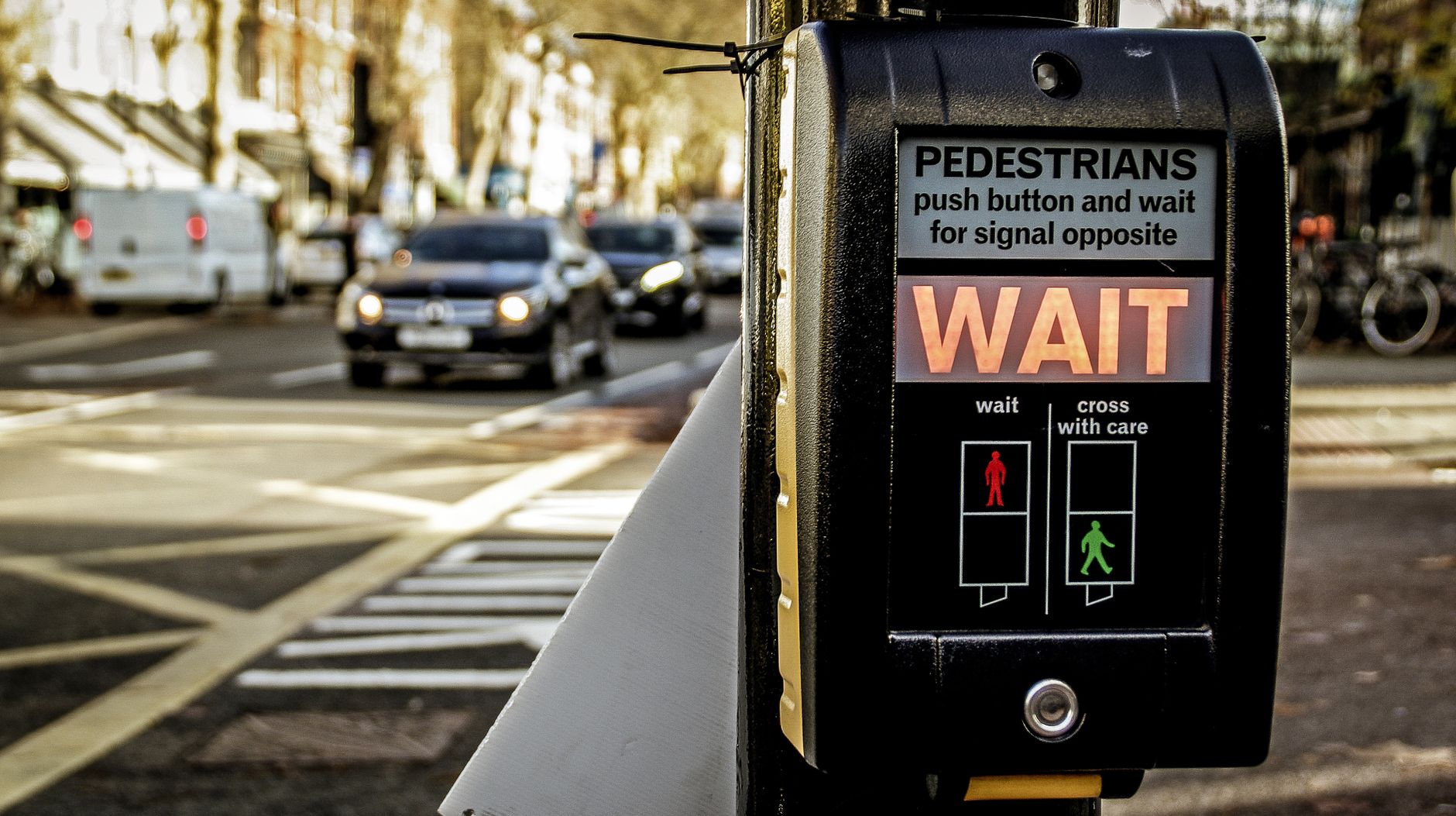
Audible pedestrian signals give pedestrians who are blind or have low vision a clear, non-visual indication of when it's safe to cross. At their simplest, they emit a repeated tone during the pedestrian walk phase and a faster, chirp-style tone for direction cues. In practice, the specification covers a range of output types, timing behaviours, and volume-control requirements that interact directly with a site's signal controller configuration and noise environment.
Australian practice is governed primarily by AS/NZS 1428.4.1:2009, the standard for tactile indicators and accessible pedestrian signals. That document defines the tone sequences, minimum and maximum output levels, and the behavioural requirements that any compliant accessible pedestrian signal (APS) device must meet. Transport authorities in each state then layer their own technical specifications on top, which is why the specific product types and controller integration requirements can vary between New South Wales, Victoria, and Queensland even when the underlying standard is the same.
What audible signals actually communicate
A basic APS device does three things. It confirms that the push button has been registered, it signals the start of the walk phase with a distinct tone, and it provides a directional orientation cue. The orientation cue is the part most often underspecified: a pedestrian at a corner with two crossing directions needs to know which crossing is active, and a simple beep from a box mounted between two crossings doesn't resolve that ambiguity on its own.
Modern APS devices address this with directional speakers angled toward the respective crossing leg and, in some implementations, a speech message that names the street. The speech output mode is also useful for communicating non-standard conditions: an extended walk phase, a split-phase arrangement, or a temporary restriction during roadworks.
Vibrotactile indication is the other accessibility channel at the push-button. A vibrating arrow mounted on the button face pulses during the walk phase, giving a tactile confirmation that mirrors the audible output. This matters at high-noise sites where sound output must compete with traffic noise, or at locations where audible output is limited after hours.
Volume control and the noise environment
Fixed-volume APS devices create a genuine problem. At a quiet suburban intersection, the maximum output needed for a busy arterial road becomes intrusive for nearby residents overnight. At a heavily trafficked urban crossing, a volume set for ambient conditions can be inaudible during peak hour.
Automatic volume control (AVC) responds to this by measuring ambient sound levels in real time and adjusting the APS output accordingly. The device uses an integrated microphone to sample background noise, then scales its output level within a defined range, typically 2–5 dB above ambient, so the signal remains audible without being excessive. Most current installations on arterial roads in Australian capital cities use AVC as standard.
Night-time volume limits are a separate consideration from AVC. Many council specifications impose a maximum nocturnal output regardless of ambient levels, requiring the controller to apply a time-of-day volume cap. This integrates directly with the signal controller's timing plan, since the controller already manages timing plan switching between peak, off-peak, and night configurations. The APS volume schedule can run on the same switching logic.
Integration with the signal controller
An APS device isn't a standalone product. It draws its walk indication directly from the signal controller's pedestrian phase output, so the controller must be wired to supply the correct activation signal to each APS unit. Depending on the controller type and the APS product family, this is achieved through direct wiring from the pedestrian phase output terminals, or via a dedicated APS interface module that the controller addresses separately.
The push-button extended walk feature adds another integration layer. When a pedestrian presses the button and holds it (or presses it twice in some implementations), some systems extend the walk phase duration to accommodate slower-moving pedestrians. The controller must be programmed to accept that extended demand and adjust the phase timing without compromising the phase structure of adjacent movements. Intergreen calculations remain fixed regardless of the walk extension, since the clearance time between conflicting phases is determined by road geometry, not by pedestrian demand. For reference on how those calculations are derived, the intergreen period calculation methodology explains the underlying approach.
At intersections with multiple pedestrian crossings, the controller must also manage simultaneous APS outputs carefully. Two opposing crossings that share the same walk phase can both sound simultaneously without confusion, but a staggered or split-phase arrangement requires that only the active crossing sounds at any given moment. Failure to configure this correctly results in audible signals that actively mislead pedestrians about which crossing is active, which is a safety defect rather than a minor commissioning oversight.
When audible signals are required
The trigger for APS installation is not uniform across Australia. At the federal level, the Disability Discrimination Act 1992 creates the broad obligation to provide accessible infrastructure, but it doesn't prescribe specific intersection types. The practical specification triggers come from state transport authority guidelines and from AS/NZS 1428.4.1.
New signalised intersections on arterial roads in most Australian states now require APS as a default. Upgrades to existing intersections trigger a review: if the upgrade involves replacing push-button hardware, signal heads, or pedestrian phases, most authority specifications require APS to be included in scope. Retrofit installations are also triggered by formal accessibility complaints or by scheduled asset renewal programmes.
Sites with particular pedestrian characteristics warrant specific attention. High-density crossing environments, locations near schools, hospitals, aged-care facilities, or transport interchanges are regularly prioritised in accessibility upgrade programmes. Understanding how pedestrian volume and movement patterns affect signal design more broadly is covered in the context of countdown timers on pedestrian signals, which shares some of the same behavioural considerations.
Common specification and installation errors
Incorrect placement of the push-button is one of the most frequent issues on completed APS installations. The button must be positioned so that a person standing at the button can identify the correct crossing direction from the tactile arrow and the audible orientation cue. A button mounted on the wrong face of a signal pole, or at a height that doesn't comply with the 0.9–1.1 m reach range in the standard, compromises the entire accessible design intent.
Speaker orientation errors are less visible but equally consequential. An APS unit with its speaker aimed 30 degrees off the crossing centreline may appear installed correctly from the footpath, but the directional cue it provides will orient a pedestrian toward traffic rather than toward the opposite kerb. This is a design-stage check as well as a commissioning check: the installer needs the crossing geometry dimensions before positioning the unit, not after.
Volume not being verified under ambient conditions is the third consistent gap. A commissioning test carried out at 7 am on a Sunday does not replicate the noise environment at a busy intersection on a weekday afternoon. APS commissioning should include at least one check during a representative peak period, with a documented ambient sound level reading alongside the measured APS output level.
Bob Panich Traffic Signals designs and supplies APS-compliant pedestrian signal systems for new intersections, upgrade projects, and accessibility retrofit programmes across Australia, working to both AS/NZS 1428.4.1 and the technical specifications of state transport authorities.