
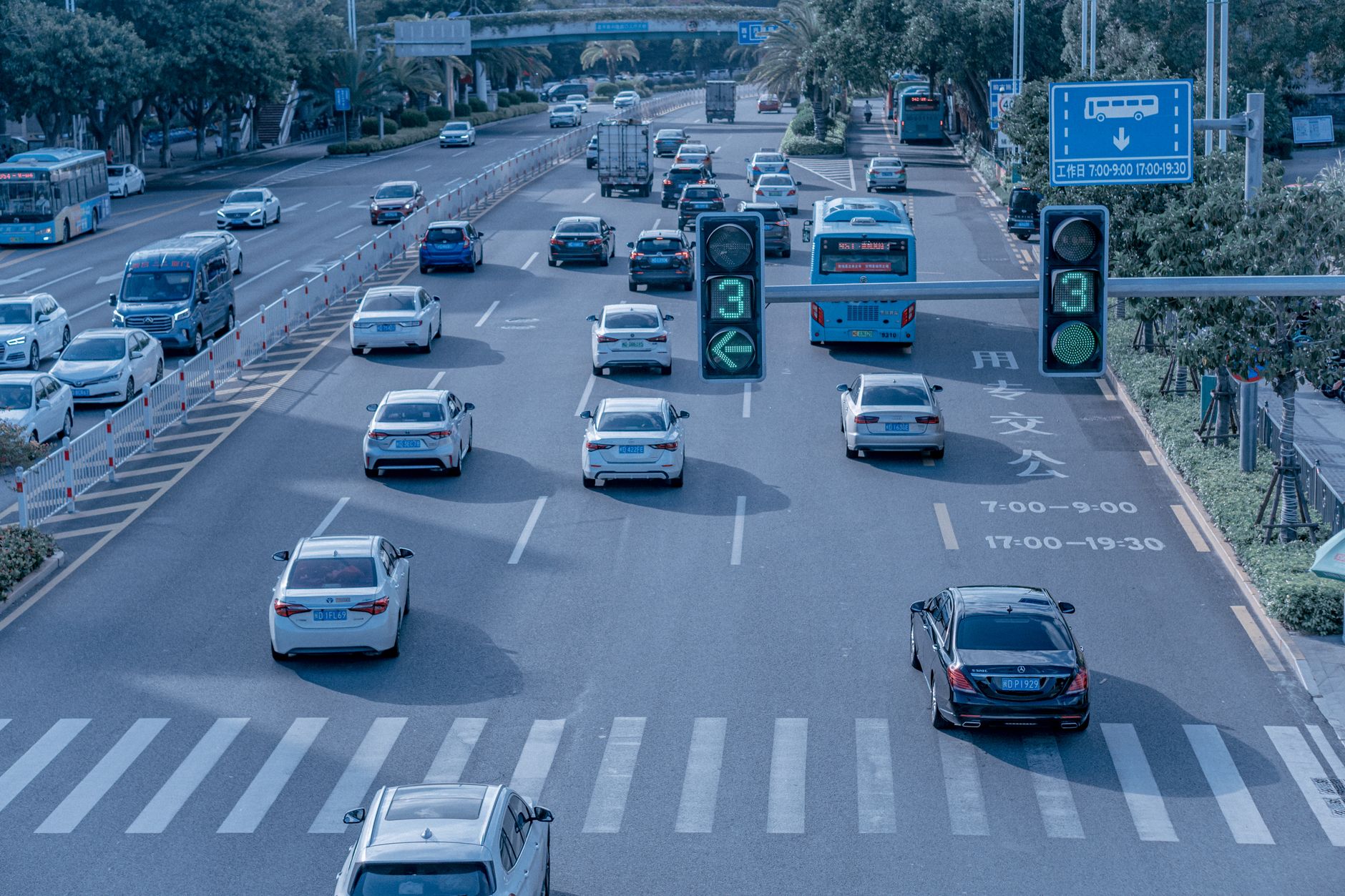
Smart intersection design sits at the operational core of modern urban traffic management. Where a conventional signalised intersection operates on fixed timing plans, a smart intersection integrates sensors, adaptive signal controllers, communications hardware, and data processing into a coordinated system that responds to conditions in real time. The difference in outcome is measurable: reduced conflict points, lower average delay, and infrastructure that can be updated in software rather than rebuilt in concrete.
What makes an intersection "smart"
The label gets applied loosely, but a genuinely smart intersection has three functional layers working together. The first is detection: knowing accurately what is present at the intersection, including vehicles queued on each approach, pedestrians waiting or mid-crossing, cyclists, and in some deployments, the approach of emergency vehicles. The second is decision-making: a controller that can adjust phase timing, sequence, and duration based on detected demand rather than a preset schedule. The third is communication: the ability to share state information upstream to a traffic management centre and, increasingly, directly with connected vehicles through V2X communication protocols.
Each layer depends on the others. High-quality detection feeding a fixed-time controller produces no adaptive benefit. A sophisticated controller fed by sparse or unreliable sensor data will make poor decisions. And communications infrastructure that cannot be secured or maintained in the field degrades quickly into a liability rather than an asset.
Sensor selection and placement
Detection is the foundation of smart intersection performance, and sensor selection is one of the most consequential early decisions in a project. The main technologies in use across Australian deployments are inductive loops, video detection, radar, and LiDAR, each with a different cost profile, maintenance demand, and capability envelope.
- Inductive loops remain reliable for basic vehicle detection on approach lanes, but they require road cutting for installation, are vulnerable to damage during resurfacing, and cannot classify vehicles or detect pedestrians.
- Video detection provides zone-based detection across multiple lanes from a single overhead mount and supports classification and queue length estimation, but performance can degrade in poor lighting or adverse weather without careful configuration.
- Radar is weather-independent and effective for measuring vehicle speed and presence, making it a strong complement to video in locations prone to fog, rain, or night-time glare.
- LiDAR offers high-resolution spatial mapping and is increasingly used in complex intersections with mixed road users, though unit costs and data processing requirements remain higher than other technologies.
Placement matters as much as technology choice. Detection zones must be positioned to give the controller enough advance notice to act on the data. Queue spillback detection, for example, requires sensors further back on the approach than standard stop-line detection. Pedestrian detection at crossings should account for the range of users, including those with mobility aids or prams, not just an average walking speed.
Adaptive signal control and timing logic
An adaptive controller does not simply respond to instantaneous demand. It projects forward, estimating how queue lengths and vehicle arrivals will evolve over the next several signal cycles, and adjusts phase parameters within defined operational constraints. The engineering challenge is calibrating those constraints so the system optimises for the right objectives, whether that is minimising average intersection delay, maximising pedestrian throughput, reducing heavy vehicle stops, or some weighted combination.
Phase sequence flexibility is a critical design choice. Some adaptive systems work within a fixed phase sequence and vary only the green durations. Others can reorder phases on the fly based on detected demand, which produces better outcomes at high-volume or geometrically complex intersections but requires more careful verification during commissioning. The degree of flexibility permitted should be set based on the intersection geometry, the mix of road users, and the risk tolerance of the approving authority.
For a deeper look at the algorithms that underpin these systems, the article on adaptive traffic signal control covers the core logic and its practical limitations in detail.
Connectivity and integration requirements
A smart intersection generates continuous data: detection events, phase state logs, fault alerts, and communications handshakes. Connectivity architecture must be specified to handle this volume reliably without introducing latency that undermines real-time control decisions. Fibre remains the preferred backhaul medium for high-density urban corridors. Wireless options including 4G LTE and 5G are viable for remote or temporarily deployed installations, but require redundancy planning and cybersecurity controls appropriate to operational technology environments.
Integration with a central traffic management platform is standard for corridor-level deployments. The intersection controller must be able to accept overrides from the centre, report faults automatically, and participate in coordinated signal progression plans without losing the ability to operate independently if the communications link drops. Fail-safe behaviour during a comms outage should be defined explicitly in the system specification, not left to default firmware settings.
Where the deployment is part of a broader smart city programme, the intersection forms one node in a wider IoT sensor network. Understanding how data flows across that network and where it is stored is important not just for system performance but for compliance with data governance requirements that increasingly apply to public-space sensing infrastructure.
Pedestrian and active transport considerations
Smart intersection design that focuses exclusively on vehicle throughput consistently underperforms. Pedestrian and cyclist demand shapes intersection geometry, phase requirements, and safe crossing timing in ways that cannot be retrofitted without significant cost. Accessible pedestrian signals, tactile ground indicators, and audible alerts must be integrated into the electrical and control design from the outset, not added as afterthoughts at construction stage.
Detection of pedestrians waiting at crossing push-buttons, or arriving without using the button in deployments using passive detection, should trigger appropriate adjustments to the pedestrian phase minimum green time. This is particularly important at intersections serving schools, hospitals, aged-care facilities, or entertainment precincts where the pedestrian population has a wide range of crossing speeds and cognitive demands.
Maintainability and lifecycle planning
A smart intersection is a combination of civil, electrical, and software infrastructure, and its lifecycle planning must account for all three. Signal heads and poles have long physical lives but their electronics require periodic replacement. Software and firmware need patch management regimes that are compatible with the operational criticality of the system. Sensor hardware, particularly video cameras and LiDAR units, has a shorter replacement cycle than the civil infrastructure supporting it.
Specifying open communication protocols and avoiding proprietary lock-in at the controller and sensor interface level is one of the most practical steps a project team can take to protect long-term maintainability. When equipment needs replacement five or ten years after installation, the ability to source compatible hardware from multiple vendors is a material operational advantage.
Asset owners who treat smart intersections as a capital expenditure rather than a managed operational asset consistently find that performance degrades well before the end of physical service life. Maintenance budgets, software update schedules, and regular performance benchmarking should be built into the project business case from the start, not negotiated away after commissioning.