
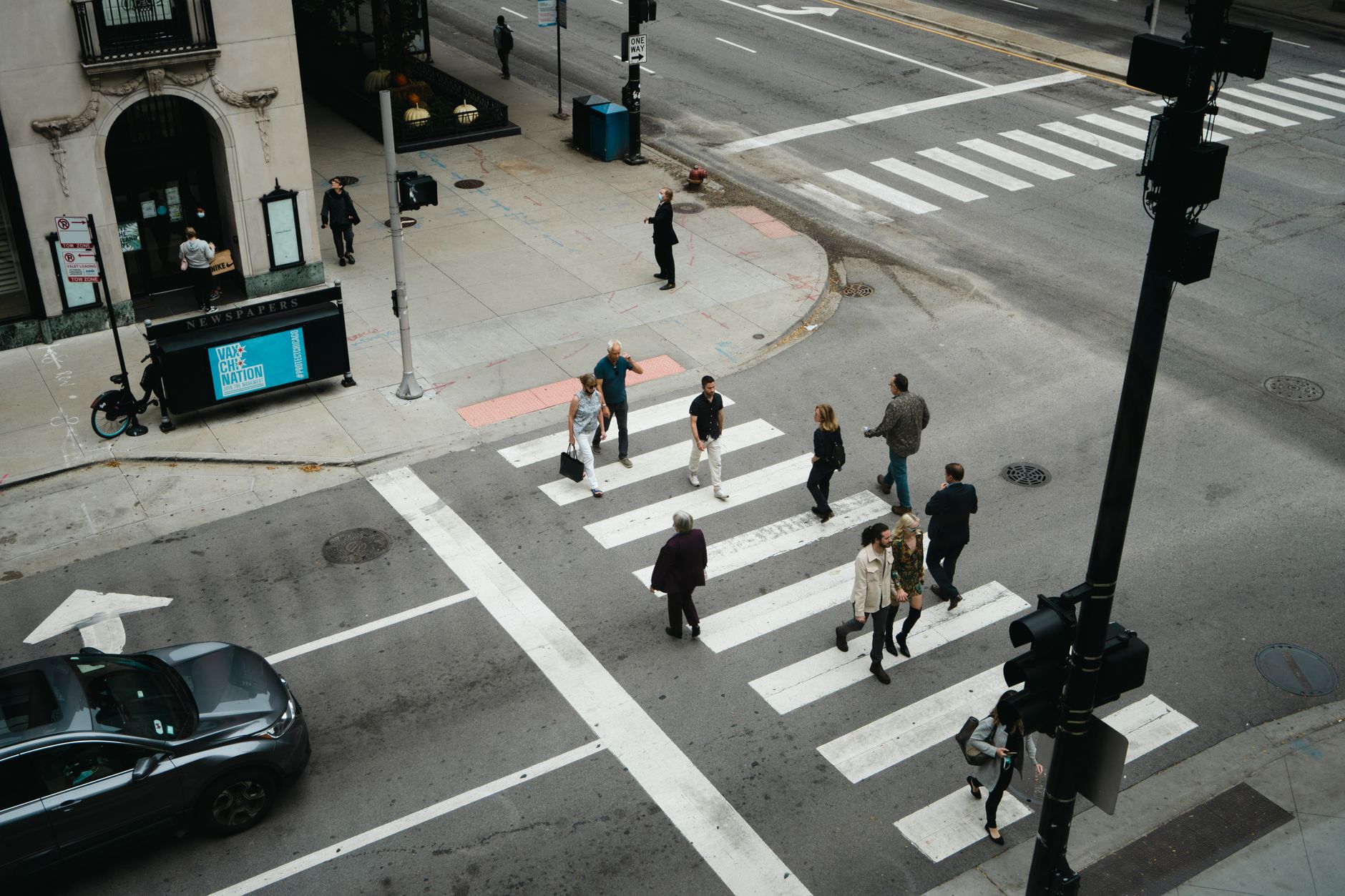
A pedestrian scramble phase, formally called an exclusive pedestrian phase or all-way pedestrian phase, stops every vehicle movement at a signalised intersection simultaneously. Pedestrians can cross in any direction, including diagonally across the full intersection. It's a well-established technique in high-density urban environments, but it's applied inconsistently across Australian cities, often because engineers underestimate the throughput cost or overestimate the safety benefit at locations where it doesn't fit. Choosing the right sites requires understanding how the scramble phase changes the signal cycle, what geometry works best, and how it interacts with adjacent intersections.
How a scramble phase changes the signal cycle
In a standard phasing arrangement, pedestrians share green time with compatible vehicle movements. A scramble phase extracts pedestrians from those combined phases entirely and gives them a dedicated all-red interval for vehicles. The cycle length grows by the duration of that exclusive pedestrian phase plus the additional intergreen time needed to clear the intersection before vehicles re-enter. On a four-way intersection with a baseline 90-second cycle, adding a 20-second scramble phase with intergreens on either side typically pushes the cycle toward 115 to 120 seconds. That's a meaningful reduction in green time available to vehicle phases, and it's why scramble phasing at intersections with high vehicle volumes can worsen queue lengths on all approaches.
The throughput cost is real, but it's predictable. Engineers can model the cycle extension against measured pedestrian demand to determine whether the location justifies it. Pedestrian signal timing in high-density areas is already one of the more demanding aspects of intersection design; the scramble phase simply concentrates the pedestrian service interval rather than distributing it across phases.
Geometry requirements that make or break the design
Not every intersection suits a scramble phase. The geometry needs to support diagonal pedestrian movement without creating conflict points inside the intersection itself. Square or near-square intersections with similar leg widths work best. Irregular intersections with offset legs, islands, or channelised turn lanes introduce diagonal crossing paths that are either too long for a single pedestrian interval or that direct pedestrians into awkward routes that defeat the purpose of all-way access.
Kerb extensions and pedestrian waiting areas also matter more than they do in standard configurations. When all pedestrians on all four corners release simultaneously, the surge of people occupying the intersection is larger than any individual phase produces. The pavement markings need to manage that flow, including clear diagonal paths at 45 degrees where diagonal movement is intended. Most Australian practitioners follow AS 1742.10 guidance on pedestrian signal facilities, and state-specific supplements from authorities including Transport for Victoria provide additional geometry requirements for exclusive pedestrian phases.
Where scramble phases genuinely improve safety
The primary safety argument for scramble phasing is the elimination of vehicle-pedestrian conflict during the crossing interval. In a standard protected-permissive phase, turning vehicles are permitted to move through a pedestrian crossing on a shared green. Crashes in that window are a documented problem at busy intersections. A scramble phase removes that conflict entirely: no vehicle moves while pedestrians cross.
Sites with the strongest case share a few characteristics. First, high pedestrian volumes on all four legs, not just two. If pedestrian demand is concentrated on one crossing, a standard pedestrian phase on that approach is cheaper in cycle time and delivers similar safety. Second, a meaningful number of turning vehicle movements. Locations dominated by through traffic, with few turning vehicles, generate fewer vehicle-pedestrian conflicts in the first place, so the scramble phase buys less safety improvement per second of cycle time spent. Third, locations with documented right-turn or left-turn conflict crash histories. The scramble phase is a targeted tool for that specific conflict pattern.
High-density CBD intersections, university campuses, and major interchange nodes near train stations typically meet all three criteria. These are also locations where adaptive signal control systems can adjust the frequency of the scramble phase dynamically, activating the exclusive pedestrian interval only when pedestrian detection confirms demand is high enough to justify the cycle extension.
Integration with detection and actuation
A fixed scramble phase that runs every cycle regardless of pedestrian demand wastes green time for vehicles without delivering proportionate benefit. Detection-actuated scramble phases, where the exclusive pedestrian interval is inserted only when pedestrian presence is confirmed on two or more approaches, recover throughput during periods of low foot traffic. Video analytics, thermal sensors, and push-button actuators can all trigger the phase, though each has different latency characteristics and detection accuracy in varied lighting and weather conditions.
The push-button remains the most common actuation method in Australian installations, partly because it's low-cost and maintenance-simple, and partly because most road authorities have existing compliance frameworks around accessible pedestrian signals that rely on push-button infrastructure. Video-based pedestrian detection is gaining ground in higher-budget installations, particularly in city cores where cabinet real estate and processing capacity support the additional hardware. Where edge-based processing is available in the traffic cabinet, video detection can run locally without round-tripping data to a central server, keeping latency below the signal timing thresholds that matter for responsive actuation.
Network effects and co-ordination with adjacent intersections
A scramble phase at one intersection affects every intersection upstream and downstream. The longer cycle at the scramble intersection breaks any existing green wave co-ordination on the corridor, unless surrounding intersections can be re-timed to accommodate the new cycle length. In practice, introducing a scramble phase at a single intersection in a co-ordinated corridor often requires retiming three to five adjacent signals to avoid creating new platoon dispersion problems.
This is one of the main reasons transport authorities in Australia tend to cluster scramble phases in CBD grids rather than applying them to arterial corridors. In a grid network, each intersection operates with some independence and the network timing plan can absorb a longer cycle at one node more readily than a linear co-ordinated corridor can. Engineers scoping a scramble phase installation should produce a before-and-after SIDRA or VISSIM model covering at least the surrounding two or three intersections to understand the network-level throughput impact, not just the target intersection in isolation.
Maintenance and compliance considerations
Scramble phases add a phase sequence step that must be correctly configured in the signal controller and verified at commissioning. The additional intergreen periods need independent calculation to AS 2144 and the relevant state supplement, ensuring clearance times account for vehicle speeds and intersection crossing distances accurately. Any error in the intergreen calculation creates a conflict window that the exclusive pedestrian phase was specifically designed to eliminate.
Ongoing maintenance includes verifying that pedestrian signal heads on all four corners display the correct indication during the scramble interval, that no vehicle phase inadvertently shows a conflicting green, and that any actuation sensors remain functional. Audit cycles for scramble phase intersections should be shorter than those for standard intersections, given the complexity of the phase sequence and the consequences of a fault during a high-pedestrian-demand period.
The scramble phase is a well-understood tool with a clear application window. Used at the right intersections, with detection-based actuation and a network timing review, it delivers safety outcomes that standard phasing can't match. Applied indiscriminately, it creates cycle bloat and corridor disruption without proportionate benefit.