
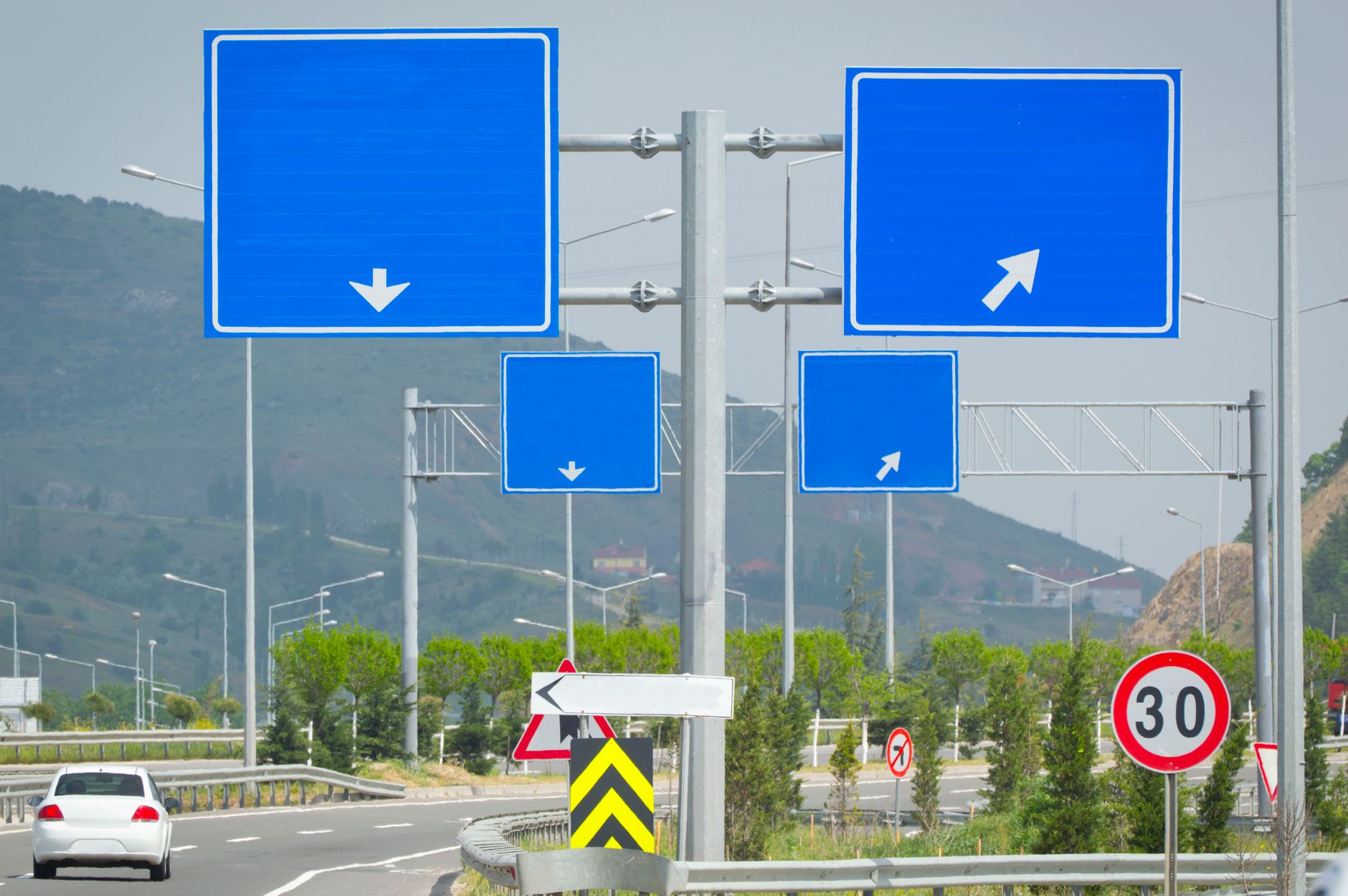
Variable message signs (VMS) are one of the most visible tools in a traffic management engineer's kit. Mounted on gantries, mast arms, or portable frames along major roads, they display dynamically updated text, symbols, and speed limits that respond to live conditions. Where a static sign can only ever communicate a single fixed message, a VMS can shift its output within seconds as an incident unfolds, a weather event develops, or a planned event generates peak demand. That flexibility makes VMS a core component of modern traffic control, particularly on high-volume arterials, motorways, and complex urban networks.
The core components of a VMS
A variable message sign is more than a display panel. The full system comprises several integrated layers. The display itself is typically an LED matrix, chosen for its visibility across a wide range of ambient light conditions and its low power draw relative to older fibre-optic or flip-disc technologies. The LED array is driven by a controller unit housed either within the sign enclosure or in a nearby roadside cabinet. That controller handles the translation of incoming commands into pixel-level display instructions, and it also manages diagnostics: tracking individual LED failures, monitoring internal temperature, and reporting faults back to the operations centre.
Communication between the sign and the traffic management centre is handled over a wide area network, most commonly via fibre-optic cable on permanent installations, with cellular or radio links used for portable or temporary deployments. The management centre software allows operators to push pre-defined message libraries or compose custom messages, often with approval workflows that prevent unauthorised content from appearing on public infrastructure. On networks where vehicle detection technology feeds live data into a central platform, VMS output can be triggered automatically based on sensor thresholds rather than requiring manual operator intervention.
Display technologies and standards
The shift to full LED matrix displays has been near-universal on new Australian installations over the past decade. LED panels offer significantly longer service life than mechanical alternatives, with mean times between failure measured in tens of thousands of hours under rated operating conditions. Brightness levels are controllable, allowing the sign to maintain legibility in direct sunlight while reducing glare at night, which is both a safety consideration and a requirement under relevant Australian standards for variable message sign installations.
Sign faces are typically classified by the number of lines they can display and the character matrix resolution available. A two-line VMS at 200mm character height suits urban arterial applications where drivers have limited approach time to absorb information. Motorway gantry signs are typically larger format with three or more display lines, and may incorporate additional panels for lane control signals (directional arrows, red crosses, or speed limit numerals) alongside the message area. Compliance with fail-safe design principles is essential: in the event of a controller fault or communication loss, the sign must default to a defined safe state, which is usually either a blank display or a pre-set message rather than a garbled or misleading output.
Where VMS fits in a signalling network
Variable message signs are rarely deployed in isolation. On managed motorways, they operate alongside ramp metering signals, lane control signals, and loop or radar detectors to form a coordinated corridor management system. An operator managing an incident in a tunnel, for example, can simultaneously activate lane closures on the approach, reduce speed limits on upstream signs, and display a diversion message on VMS units further back in the network, all from a single interface. The sign acts as the human-readable output layer for decisions that may be generated partly by algorithm and partly by operator judgement.
In urban networks, portable VMS trailers play a significant role during roadworks, events, and emergency diversions. These units are self-contained, typically solar-powered with battery backup, and can be repositioned as the traffic management plan evolves. Remote management capability is standard on modern units, allowing operators to update messaging without a site visit. For large-scale events where traffic demand changes rapidly across multiple zones, a coordinated fleet of portable signs connected to a central platform provides the kind of responsive, field-adjustable traffic information that static signage simply cannot deliver.
Message content and human factors
The effectiveness of a variable message sign depends as much on what it displays as on the hardware itself. Road authorities in Australia generally follow established guidelines for VMS message design, limiting displayed messages to short, unambiguous text that can be read and understood within the available approach distance. Messages that are too long, too complex, or that mix multiple pieces of information in a single display cycle risk information overload and may actually reduce driver compliance or increase hazard through distraction.
Best practice is to use pre-defined message libraries for common scenarios (road works ahead, incident ahead, speed limit changes, weather warnings) and to restrict freeform messages to situations where no library entry applies. Consistent language and symbol use across a network also supports driver familiarity: a driver who encounters the same message format on multiple occasions is more likely to respond correctly and quickly. This consistency requirement feeds back into the controller software configuration and the approval workflows in the management centre.
Integration with adaptive and connected systems
As traffic networks move toward higher levels of automation, variable message signs are increasingly integrated with adaptive signal control platforms and broader smart city data layers. When a central system detects queue spillback on a motorway off-ramp affecting an adjacent signalised intersection, an automated rule set can trigger a VMS message upstream while simultaneously adjusting signal timing downstream. This kind of cross-system coordination reduces the lag between a detected condition and an appropriate road-user response, which is particularly valuable in fast-moving incident scenarios.
The emergence of 5G connectivity in smart city infrastructure is opening further possibilities for VMS integration, including lower-latency command delivery and the ability to support denser networks of roadside devices without the cabling constraints of legacy fibre installations. For engineers specifying new VMS deployments, understanding how a sign's communications interface will map to the evolving network architecture is as important as the display specification itself.
Maintenance and lifecycle considerations
Variable message signs installed on high-traffic roads are expected to operate continuously across a wide range of environmental conditions: coastal salt air, inland dust, temperature extremes, and UV exposure all degrade components over time. Specifying enclosures to appropriate ingress protection ratings, selecting LED drivers rated for wide temperature ranges, and designing for front-access maintenance (to avoid lane closures for routine servicing) are all decisions that affect long-run cost and availability.
Condition monitoring via the built-in diagnostics port allows maintenance teams to identify partial LED failures or power supply degradation before they become full outages. On networks with a large sign population, aggregating fault data through the traffic management centre gives asset managers a clear picture of fleet health and supports predictive maintenance scheduling rather than reactive response. For transport authorities and councils managing significant VMS assets, integrating sign health data into broader asset management platforms is a straightforward step that has a measurable effect on availability and lifecycle cost.
Whether deployed as permanent motorway infrastructure or as part of a temporary works scheme, variable message signs remain one of the most direct and operationally flexible tools available for communicating with road users in real time. Getting the technology specification, message design, and network integration right from the outset determines how well that capability translates into measurable outcomes on the road.