
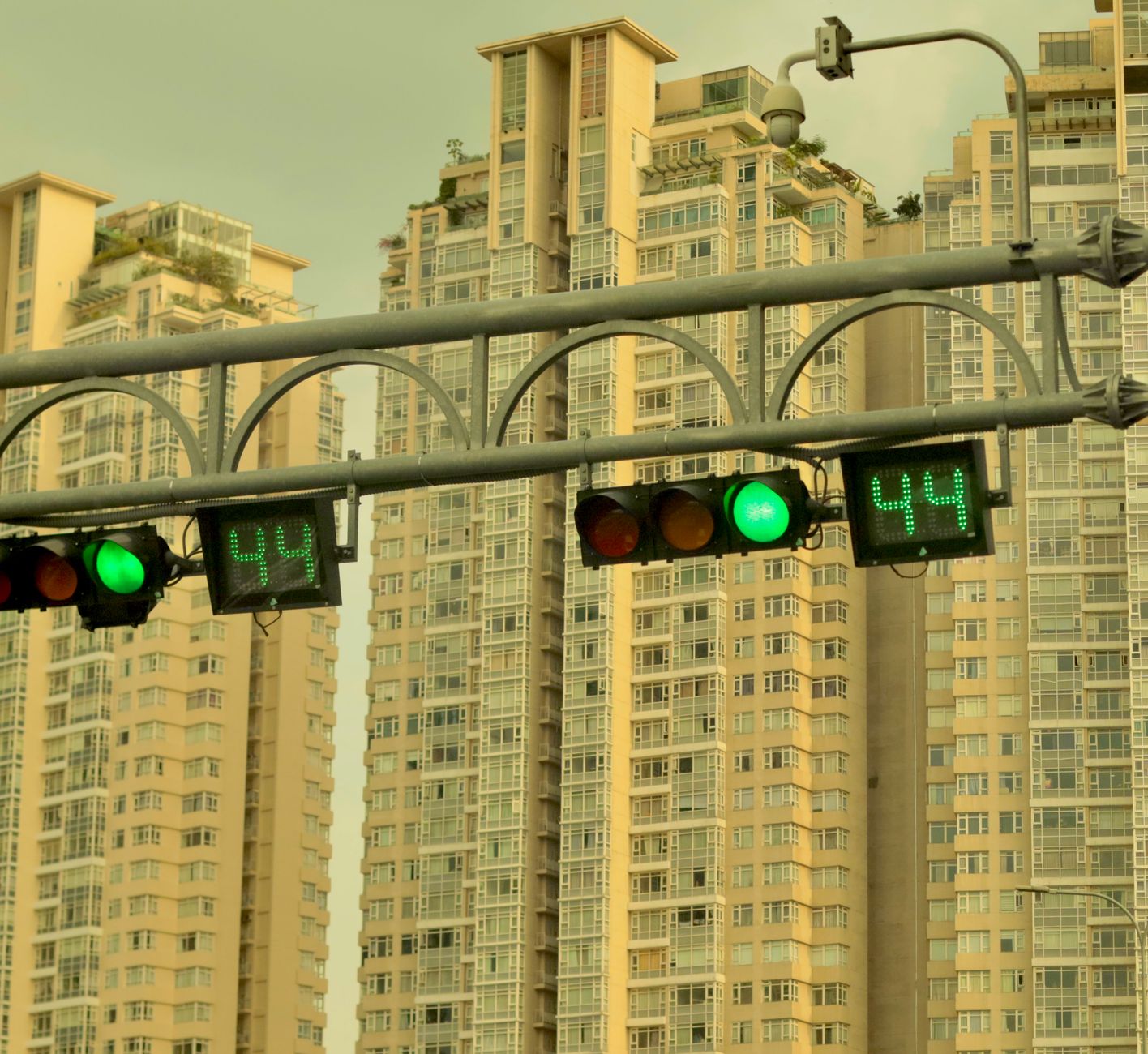
Signal phase and timing plans sit at the core of every signalised intersection. They determine which movements get the right of way, in what sequence, and for how long. A poorly constructed timing plan doesn't just create delay; it generates conflict points, frustrates pedestrians, and erodes the safety margins that intersection design depends on. Getting the plan right means understanding the relationship between geometry, demand, and control objectives before a single timing value is entered into a controller.
What a signal phase actually is
A phase is a defined period during which a specific set of movements receives a green indication. Most practitioners think of phases in terms of vehicle movements, but pedestrian phases and bicycle phases carry the same structural logic. Each phase has a minimum green time, a maximum green time, and transition periods covering yellow and all-red clearance intervals. The sequence of phases through one complete cycle is what engineers call the phase plan.
The number of phases in a plan is a product of the intersection geometry. A simple two-leg crossing may operate on two phases. A complex multi-lane intersection with protected turn movements, a mid-block pedestrian crossing, and a bus priority lane can demand eight or more. Each additional phase adds cycle length, which means every movement waits longer per cycle. Keeping the phase count as low as geometry and safety allow is a core design discipline, not an afterthought.
Building a timing plan from traffic data
The starting point is demand: how many vehicles, pedestrians, and cyclists use each movement during the period the plan is meant to serve. Timing plans are rarely built for an average hour. Engineers typically design separate plans for the AM peak, PM peak, inter-peak, evening, and overnight periods, because the ratio of competing demands shifts substantially across those windows.
From demand data, engineers calculate saturation flow rates for each approach lane. Saturation flow is the rate at which queued vehicles discharge through the stop line under continuous green. It's expressed in vehicles per hour of green per lane, and it varies with lane width, grade, turning radius, and heavy vehicle mix. Knowing the saturation flow lets engineers calculate the green time each phase actually needs to serve its demand without residual queuing.
Cycle length comes from balancing those competing demands against each other. Too short a cycle and phases don't get enough green to discharge their queues. Too long and drivers sit through extended red times, which increases the temptation to run late yellows. The practical range for most urban intersections sits between 60 and 120 seconds, though high-volume arterials and complex multi-phase plans can justify longer cycles.
Minimum green times are set independently of demand. They exist to ensure that a vehicle arriving on the leading edge of green has time to clear the intersection, and that pedestrians who have pressed the button have enough time to cross safely. These minimums act as a floor the plan can't go below, regardless of what the demand calculation suggests.
When timing plans need to change
A timing plan is calibrated against the demand conditions that existed when it was built. Those conditions shift. Land use around an intersection changes when a new development opens. A school that once generated a distinct morning peak closes or relocates. A freight route is reclassified, pushing heavy vehicles through an intersection that wasn't designed for that load. Any of these changes can render a previously accurate timing plan incorrect within months.
The trigger for review isn't always dramatic. Gradual demand growth on a single approach can push one phase past its capacity without obviously degrading the others, at least not at first. Cycle overflow, where a phase can't discharge its queue within the allocated green, tends to compound: the queue carries over to the next cycle, the next, and the next, until the approach is effectively blocked. By the time the problem is visible to a passing observer, the delay has often been building for weeks.
Scheduled reviews are the standard response. Most transport authorities in Australia require that timing plans for high-volume intersections are assessed on a defined cycle, commonly every two to three years, with additional reviews triggered by development approvals or measured changes in turning counts above a threshold. The Australian Transport Assessment and Planning framework provides the broader context within which these reviews sit, linking signal timing decisions to corridor-level performance objectives.
Adaptive systems handle some of this automatically. Rather than operating from fixed timing plans, adaptive traffic signal control adjusts phase durations cycle by cycle in response to real-time detection data. That doesn't eliminate the need for timing plan design; it shifts the design task from setting fixed values to configuring the bounds and rules within which the adaptive algorithm operates. The minimum and maximum green times, the phase sequence, and the safety clearance intervals all still need to be set by an engineer.
Common design errors and how they compound
Underestimating pedestrian crossing time is one of the most frequent errors in timing plan design. Pedestrian walk speeds vary widely across the population. The 1.2 metres per second design speed used in older Australian guidelines doesn't serve older pedestrians, people with mobility aids, or parents with prams. Where these groups make up a significant share of crossing demand, the walk phase needs to be calculated against a lower assumed speed, typically 0.8 to 1.0 metres per second.
Insufficient all-red clearance is another recurring problem. The all-red period exists to clear vehicles that have legally entered the intersection on yellow before conflicting movements receive green. Its length depends on the distance a vehicle must travel to clear the most distant conflict point, divided by a conservative exit speed. Shortening all-red to save cycle time is a false economy; it compresses the safety buffer between conflicting streams.
Overlap phasing errors are subtler but consequential. When two movements share a common green period (an overlap), the geometry of that overlap must be checked carefully. A right-turn movement that overlaps with a pedestrian phase on the same leg creates a conflict unless the pedestrian phase is specifically protected. These errors are easier to catch during design review than after commissioning, which is why quality assurance in traffic signal projects needs to include a dedicated phase conflict check as a formal stage gate, not an informal walkthrough.
Documentation and version control
A timing plan is a live engineering document. It should carry a version number, a design date, the traffic count data it was based on, and the name of the engineer who approved it. When a plan is updated, the superseded version should be retained and filed against the intersection record. This matters for incident investigation: if a collision occurs at a signalised intersection, the timing plan in effect at the time is the first document a regulator will request.
Controller manufacturers including Swarco now provide software tools that store timing plan versions against controller firmware records, making audit trails easier to maintain across large signal networks. Bob Panich Traffic Signals integrates timing plan documentation into its commissioning and handover process, ensuring that every intersection Bob Panich Traffic Signals delivers includes a complete record of design assumptions and the count data that supports them.
Timing plan design is one of the less visible parts of traffic signal engineering. It doesn't generate photographs or ribbon cuttings. But it's the layer where most of the safety and efficiency value of a signalised intersection is either created or lost, and it deserves the same rigour as the hardware selection and civil works that surround it.